
From the Sensex basket, Maruti, Mahindra & Mahindra, NTPC, JSW Steel, Larsen & Toubro, Reliance Industries, Axis Bank, and Power Grid were the major gainers. Nestle, Wipro, Tata Consultancy Services, HDFC Bank, Titan, HCL Technologies and Infosys were the laggards.

The S&P BSE Sensex ended up 28 points at 25,844 and the Nifty50 ended flat at 7,915.

Tata Motors on Tuesday said its electric vehicle arm has reduced prices of two models -- Nexon.ev and Tiago.ev -- by up to Rs 1.2 lakh on account of reduction in battery cost. The auto major has cut the price of Nexon.ev by up to Rs 1.2 lakh and now the model price starts at Rs 14.49 lakh. Similarly, the company has reduced the prices of Tiago.ev by up to Rs 70,000 with the base model now starting at Rs 7.99 lakh, Tata Motors said in a statement.

The Delhi battlefield may not be a cakewalk for the Rhodes Scholar.

FMCG major Hindustan Unilever on Wednesday reported a 1.53 per cent decline in consolidated net profit to Rs 2,561 crore for the fourth quarter ended March 31, 2024 due to factors such as deflation and softening of commodity prices. The company had posted a net profit of Rs 2,601 crore in the year-ago period, according to a regulatory filing from HUL. Net sales of Hindustan Unilever Ltd (HUL) were almost flat to Rs 15,013 crore in the March quarter.

Mahindra & Mahindra (M&M) reported very strong results for the January-March quarter of the last financial year (Q4FY24), beating consensus comfortably. The margins of the automobile business improved 170 basis points (bps) year-on-year (Y-o-Y) to 8.8 per cent, while FES (Farm Equipment Sector) margins improved to 15.8 per cent (up 60 bps Y-o-Y), despite a decline in volumes due to cost optimisation and lower raw material costs.

The stock of Mahindra & Mahindra (M&M) has been touching successive all-time highs on the bourses and, over the past year, gained 81 per cent. While the S&P BSE Auto Index has not performed poorly, registering gains of 73 per cent, it still trails the company by 800 basis points (bps) during this period. There are multiple reasons why investors are beating a path to M&M's counter.

Marico's January-March quarter (Q4) results were slightly better than consensus. Revenue was up by 1.7 per cent year-on-year (Y-o-Y) to Rs 2,280 crore. Ebitda grew by 12.5 per cent Y-o-Y to Rs 440 crore. Adjusted PAT was up 10.3 per cent Y-o-Y to Rs 320 crore.

Titan Company on November 21, became the second Tata group firm to join Rs 3 trillion market capitalisation (market cap) club after its shares hit a new high of Rs 3,400, up nearly 2 per cent on the BSE in Tuesday's intra-day trade. At 12:28 PM; with a market cap of Rs 301,847 crore (Rs 3.02 trillion) Titan stood at number 16th position in overall market cap ranking on the BSE listed companies, the exchange data shows. Titan overtook paint company Asian Paints, which has a market cap of Rs 300,579 crore, data shows.

Indian engineering research and development (ER&D) players, such as Tata Technologies, Tata Elxsi, and Cyient, among others, had a subdued January-March quarter of 2023-24. The outlook for 2024-25 (FY25) also remains unexciting amid weak discretionary spending, prompting analysts to revise their growth expectations for the ongoing financial year (FY25).

'If such a practice were feasible, every state would seek additional funds, posing a significant risk to the overall health of the economy.'

Gains in IndusInd Bank, HCL Tech, TCS, Tech Mahindra, NTPC, ITC, JSW Steel and Tata Steel helped the barometer scale a fresh high. Axis Bank fell the most by 1.26 per cent, M&M by 0.99 per cent and Hindustan Unilever by 0.67 per cent. Maruti, Bajaj Finserv, Bharti Airtel and HDFC Bank and Infosys also declined.

Public sector banks (PSBs) have delivered significant outperformance over the past three years and the sector has been re-rated. Given the growth and profitability expectations of an 18 per cent return on equity (RoE) over FY24-26, there is still a case for buying at the current levels. While the net interest margins or NIMs may remain range-bound or have a downward bias, there's optimism about possibly better opex ratios and lower non-performing assets (NPAs), plus scope for further credit cost reduction, and healthy treasury performances as interest rates trend down.

'If India feels that they need only one fast bowler, then having Kuldeep will certainly help.'

It is usually better to buy those shares which are members of an industry group which is leading the market's move.

The share of listed public sector undertakings (PSUs) in the overall market capitalisation has hit a three-year high of 11.4 per cent. This comes on the back of the sharp outperformance of the PSU pack over the past two years. In 2021 and 2022, the BSE PSU index gained 41 per cent and 23 per cent, respectively. Market participants said a combination of factors like value buying and bullishness, particularly in public sector banks (PSBs), were the reason for the improved prospects.

For over a decade, HDFC Bank consistently outperformed industry growth rates in both deposits and advances, maintaining impeccable asset quality. Amid a landscape where other banks struggled with soaring non-performing assets (NPAs), HDFC Bank thrived, eventually surpassing ICICI Bank to become the largest private sector lender in India. Its net interest margin (NIM) remained stable in the range of 4.1-4.4 per cent.
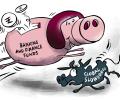
Even as banks and finance companies are reporting record-high earnings, their weighting in the benchmark National Stock Exchange Nifty50 Index has seen a downward trajectory. Investors expect a stronger performance from other sectors in the new year. Currently, banking, financial services and insurance (BFSI) companies collectively hold a weighting of 34.5 per cent, down from 36.7 per cent at the end of December 2022 and a record high of 40.6 per cent at the end of December 2019. This represents the sector's lowest weighting in the index since December 2021 when it stood at 33.7 per cent.

Shares of Avenue Supermarts, which owns and operates the DMart stores, hit a two-year high of Rs 4,710.15 as they surged nearly 6 per cent on the BSE in Thursday's (April 4) intraday trade after reporting strong revenue growth in the January-March quarter (Q4) of the previous financial year (FY24). DMart, in the Q4FY24 pre-quarter update, said the company reported 20 per cent growth in standalone revenue from operations at Rs 12,393 crore, as against Rs 10,337 crore in the third quarter (Q3) of 2022-23 (FY23), driven by a 7 per cent growth in revenue per store and a robust 13 per cent year-on-year (Y-o-Y) increase in store additions. In Q3 of 2021-22, the company reported revenue of Rs 8,606 crore and in Q3 of 2020-21, it posted revenue of Rs 7,303 crore.

In the Sensex pack, HCLTech rose the maximum by 3.12 per cent, followed by ITC which gained 2.73 per cent and M&M went up 2.61 per cent. TCS climbed 2.44 per cent. Tech Mahindra, Wipro, L&T and Maruti were among the other major gainers.

After a sharp fall in the share prices of HDFC Bank and other private sector lenders in the past three days, the BFSI (banking, financial services and insurance) sector weighting in the Nifty50 has slipped to a seven-year low of 32.03 per cent, down from nearly 36.6 per cent at the end of March 2023 and 34.5 per cent at the end of December 2023.

This period of strong growth not only offers opportunities but also calls for strategic considerations to ensure sustainable development and equitable prosperity in the years to come, suggests Sujan Hajra.
Shares of ICICI Bank may outperform those of HDFC Bank in the near-term, analysts said recently, after the Sandeep Bakhshi-led private sector lender reported a strong set of numbers for the July to September quarter (Q2) of financial year 2023-24 (FY24). The result, they said, reiterated that ICICI Bank is maintaining a sustainable and prudent growth led by tech-driven initiatives as against HDFC Bank, which is facing merger related challenges. According to analysts at Prabhudas Lilladher, ICICI Bank is valued at par with HDFC Bank at 2.2x/1.9x on FY25/26E core adjusted book value (ABV) basis.

In November, DRL registered growth of 28 per cent year-on-year (YoY), which was the highest among peers and double that of the industry growth (14.5 per cent).

From its lows this month, the stock of Sona BLW Precision Forgings is up 10 per cent on better-than-expected results. The stock rose by 4 per cent in the trading session on Tuesday after Japan's Nikkei Group said the Indian automotive component major has topped its rankings in terms of competitive advantage. The rankings are based on sales, profit margin, capital expenditure, research and development, and market capitalisation.


The Street's optimism on India's largest listed automotive maker by market capitalisation is not misplaced, given the robust wholesale performance in recent months and the strong 2023-24 (FY24) October-December (Q3) results.

Global private equity (PE) firms are successfully offloading large equity stakes in domestic companies in the open market, taking advantage of buoyant conditions. Strong domestic liquidity support and an upward trending market have underpinned over a dozen PE exits worth $2.5 billion, data compiled by Business Standard shows. The figures exclude PE exits during maiden share sales and shares sold by strategic investors, such as SoftBank and Ant Group in new-age companies.

Rekha Jhunjhunwala's net worth has increased by more than 7 per cent, or Rs 2,865 crore, compared to less than 1 per cent rise in the BSE Sensex.

'Investing in the stocks of holdcos can be a very efficient and inexpensive way of gaining exposure to the stocks of India's reputable growing business houses.'

Indian equity markets had a good run in the first half of calendar year 2023 (CY23), with the S&P BSE Sensex and the National Stock Exchange Nifty50 hitting fresh 52-week highs. While the Sensex scaled up to a peak 64,718, the Nifty50 hit Mt 19,189. As the markets now prepare to enter the second half (H2) of CY23, all eyes are on global central banks, especially the US Federal Reserve, as to when they will pause and pivot as regards their interest-rate cycle.

Most market analysts are expecting the momentum to shift towards 'quality' and 'growth' stocks in 2024 after the outperformance of 'value' stocks over the past three years. 'Value' stocks are generally well-established companies with steady profits that are trading at a discount to what they are intrinsically worth. Companies in sectors such as commodities, industrials, commercial vehicles and public sector units (PSUs) fall in this bracket.

Bajaj Auto's market capitalisation (market cap) hit Rs 2 trillion mark for the first time. The stock of the two and three-wheeler major rallied 6 per cent to hit a new high of Rs 7,420 on the BSE in Tuesday's (January 9) intraday trade after its board approved Rs 4,000 crore share buyback at Rs 10,000 per share. The stock ended the day at Rs 7,093.75, up 1.55 per cent and its market cap a shade above Rs 2 trillion.

HDFC Bank's market capitalisation (market cap) touched Rs 13 trillion in Thursday's (December 28, 2023) intra-day trades as the largest private sector lender is set to report its sharpest monthly rally in the past two years. At 10:33 AM; HDFC Bank's market cap stood at Rs 13.03 trillion, the BSE data shows. The stock was up 1 per cent at Rs 1,717.90 in intra-day trades on December 29, inching towards its record high of Rs 1,757.80 touched on July 3, 2023.

Water projects firm Vishnu Prakash R Punglia, the 20th company to launch its IPO in the current year, saw its shares closing at a 47 per cent gain over its issue price on Tuesday. Such a huge one-day pop is considered rare; however, it has become the norm this year. The average listing-day gain for these 20 IPOs in 2023 is 34 per cent, and their average gain to date stands at 46 per cent.

HCL Technologies was the biggest gainer in the Sensex pack, rising 5.58 per cent, followed by Tata Consultancy Services and Infosys, State Bank of India, Tech Mahindra, Tata Steel, NTPC and Wipro. In contrast, Nestle, Bharti Airtel, Maruti and ITC were among the laggards.

Asia to stay flat in 2017. India is better-placed given its low export dependence and it should outperform Asian peers this year says Mixo Das, India strategist for financial major Nomura

The improvement in the performance of actively managed mutual fund (MF) schemes is acting as a key tailwind for the nearly Rs 50 trillion industry, Kotak Institutional Equities (KIE) said in a report. The report adds that the two largest listed asset management companies (AMCs) - HDFC and Nippon India - are likely to be the biggest beneficiaries. "The industry has a solid track record of delivering alpha on 10-year returns (70-80 per cent of assets under management (AUM) beat the benchmark), with shorter duration performance also on an upswing.

BSE Midcap index outperformed the benchmark indices to end with 0.4% gains.

Brokerages have maintained their ratings and target prices on FSN E-Commerce Ventures, the parent company of Nykaa, after the fashion and beauty online retailer posted in-line numbers during the October-December quarter (Q3) of financial year 2023-24 (FY24). They have, however, cut earnings before interest, tax, depreciation, and amortisation (Ebitda) estimates after weak demand weighed across line items in Q3. "While revenue growth was healthy at 22 per cent year-on-year (Y-o-Y), gross margins declined 90 basis points (bps), weighed by higher discounting in own brands and lower ad income.
 © 2026 Rediff.com - Investor Information - Advertise with us - Disclaimer - Privacy Policy - Sitemap - Feedback - About us - Terms of use - Grievances